Choosing the best Portable Cart can shape your daily workflow, customer experience, and operating costs. A suitable cart should match your products, selling environment, staff, and transport routine. A café cart needs different features from a market display cart. Measure the intended space carefully. Check door widths, storage corners, elevator access, and vehicle capacity. Small details matter.
Practical evaluation should begin with load capacity, wheel quality, braking, handle height, and surface durability. A cart carrying drinks may need sealed shelves and easy-clean panels. A retail cart may require adjustable displays, locking storage, and stronger visual appeal. Test the cart on pavement, ramps, and uneven floors before making a decision. It should move smoothly.
Consider materials, maintenance, warranties, and replacement parts. Stainless steel handles frequent cleaning, while coated aluminum can reduce weight. Larger wheels often perform better outdoors, but they may increase the cart’s overall size. No cart is perfect. A lighter model may sacrifice stability. A stronger frame may cost more and demand extra storage space. Review manufacturer specifications and relevant safety guidance before purchasing. Reliable sellers should explain weight limits clearly and provide practical support after the sale.
This guide compares key features through a business-focused lens. It also highlights common buying mistakes, including choosing appearance over function. Your ideal Portable Cart should support real work, not simply look impressive in photographs. Take time to test it. The right choice should feel dependable during busy hours.
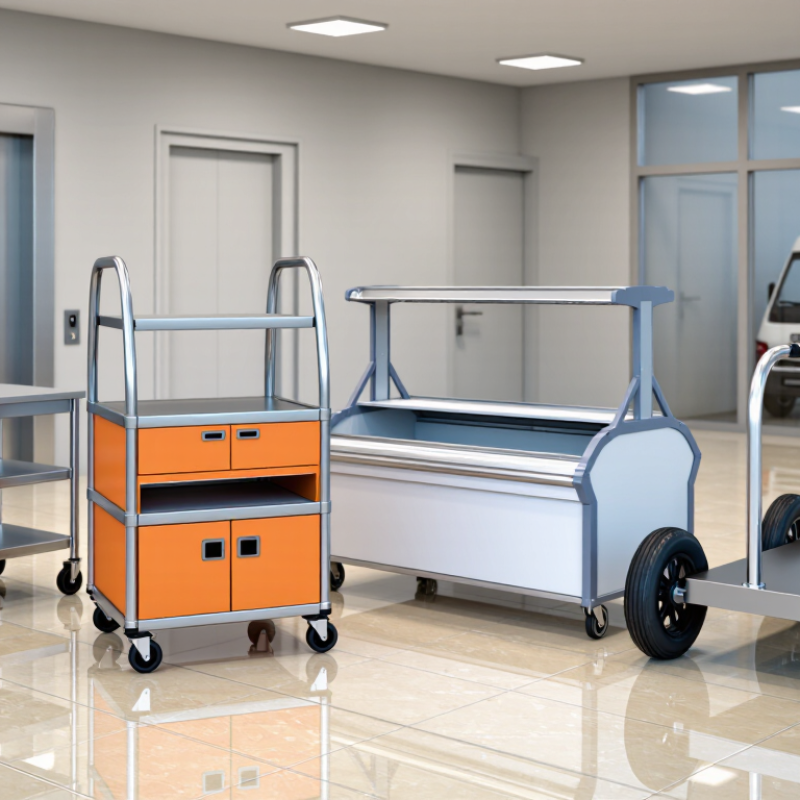
How to Choose the Best Portable Cart for Your Business?
Define Your Business Needs and Cart Usage
Start by describing the cart’s real working environment, not an ideal one. Will staff move it across smooth floors, outdoor paths, ramps, or uneven warehouse surfaces? Measure doorways, elevator openings, storage spaces, and turning areas before comparing models. Measure everything.
List the items the cart will carry during a normal shift. Include their combined weight, shape, height, and frequency of movement. A cart holding sealed containers needs different features from one carrying delicate tools or printed materials. Check the platform size, handle height, wheel diameter, locking system, and load rating. Leave extra capacity for busy days.
Think beyond today. If your team often adds supplies halfway through a task, a narrow cart may create repeated trips. If workers push it for several hours, poor handle comfort can cause fatigue. Ask employees to test a loaded cart on the actual route. Their feedback may reveal problems that product descriptions miss.
I once focused too much on maximum load capacity and overlooked storage height. That assumption failed when the cart blocked a service cabinet. A practical choice balances capacity, maneuverability, cleaning needs, and available space. Record how often the cart is used, who operates it, and what slows them down. Recheck these details after one week of use. Small observations can change the right specification.
Choosing the best portable cart starts with comparing cart types, not just prices. A folding cart suits pop-up sellers who need compact storage. A platform cart works better for boxes, equipment, and heavier loads. A utility cart offers shelves for tools or supplies, but it may need more storage space. I once chose a narrow folding model for crowded events. It stored easily, yet its small wheels struggled on uneven pavement.
Size should match both your products and your working environment. Measure doorways, vehicle space, aisles, and turning areas before buying. A cart that is too wide slows movement and creates awkward handling. Check the usable platform length and width, not only the outside dimensions. Weight capacity also deserves careful attention. Add the weight of products, containers, and display materials. Then leave a safety margin of at least 20 percent. Overloading can affect balance, wheel performance, and braking control.
Tips:
Test the cart with a realistic load before regular use. Push it across tile, pavement, ramps, and carpet. Notice vibration, handle comfort, and wheel tracking. Larger wheels usually roll more smoothly over rough ground. Smaller wheels can turn more easily indoors. For frequent lifting, choose a lower platform height. This reduces repeated bending. I would also inspect bolts and wheel attachments weekly. That habit feels excessive at first, but small looseness can become a frustrating problem. Compare capacity labels carefully, because some ratings assume evenly distributed weight.
Choosing a portable cart starts with its materials, not its appearance. Steel handles repeated impacts and heavier loads, while aluminum reduces weight and resists corrosion. High-quality polymer shelves can absorb moisture, but cheap plastic may flex under heat. The 2024 Global Material Handling Equipment Market report by Grand View Research identifies durability and operational efficiency as major purchasing factors. That sounds obvious, yet many buyers still judge carts by color and price.
Mobility needs practical testing. Measure wheel diameter, turning radius, floor clearance, and braking strength. Larger casters usually cross door thresholds more smoothly. Swivel wheels improve maneuverability, but they may wander on sloped floors. The Liberty Mutual Workplace Safety Index reported that overexertion caused approximately 23% of the leading U.S. workplace injury costs in its latest published analysis. A poorly balanced cart can increase pushing effort. Test it fully loaded, not empty. That detail is often missed.
Storage features should match real workflows. Look for adjustable shelves, vertical handles, lockable compartments, and cable-friendly gaps. A narrow cart may fit a service corridor but waste time when items cannot be reached quickly. Measure the smallest doorway first. Do not trust listed dimensions alone; wheel housings and handles add space. I would also inspect welds, fasteners, and replacement-wheel availability. The wrong cart can still function, just inefficiently. That is the uncomfortable part. Trial runs with actual staff may reveal problems that specifications never show.
How to Choose the Best Portable Cart for Your Business?
A portable cart must protect people before it carries products. Check the frame for sharp edges, loose joints, and unstable corners. Test it loaded. Place the heaviest normal load inside, then push it across a slightly uneven floor. Watch for sudden wheel wobble or handle flex. Brakes should engage firmly without forcing your foot or hand. Wheels also need enough grip for ramps, warehouse dust, and smooth tile. Small flaws matter.
Durability depends on materials, joints, and daily handling. A reinforced frame may withstand repeated loading better than a thin frame with decorative panels. Inspect welds, fasteners, and the connection between the handle and base. Ask for a stated load limit, then stay below it during regular work. Real conditions are rarely gentle. I once underestimated how quickly overloaded carts damaged their wheels. That mistake made replacement costs obvious.
Maintenance requirements can decide whether a cart remains useful. Choose accessible wheels, replaceable fasteners, and surfaces that clean easily. After each shift, remove debris from wheel housings and check brake response. Lubricate moving parts only when the maintenance instructions allow it. Record cracks, unusual noise, and uneven rolling. Do not ignore repeated problems. A simple weekly inspection is practical, but busy teams may skip it. That weakness needs a visible checklist near the storage area.
Evaluate portable carts by giving greater priority to safety, followed by durability and maintenance requirements. This practical weighting helps balance daily protection, long-term use, and operating effort.
Selection priorities: Safety accounts for 40% of the decision, durability for 35%, and maintenance requirements for 25%. Check load stability, wheel and brake performance, frame strength, corrosion resistance, cleaning access, and replacement-part availability before purchasing.
Choosing a portable cart is less about finding the lowest price and more about understanding what that price includes. Compare the frame, wheels, shelves, and any setup fees. A cart that rolls smoothly across a shop floor may struggle on cracked pavement, so consider where it will actually travel. Ask for dimensions and load limits in writing. Small details matter. A narrow aisle can make an oversized cart frustrating, while weak casters may need early replacement. Include delivery, assembly, and likely maintenance in your cost estimate. The cheapest quote can become expensive when these items are missing.
Customization should solve a real working problem, not simply add features. Think about the height of the handle, shelf spacing, storage bins, and whether staff need to move the cart through doorways. Request a drawing or sample configuration before approving a custom build. Changes after production starts may add time and cost. There is a trade-off: too many special features can make repairs harder. Supplier support deserves the same scrutiny. Ask how quickly replacement wheels or parts can be supplied, what the warranty covers, and who handles questions after delivery. A clear answer is useful evidence; a vague promise is not. I have seen planning overlook one awkward step near a loading area. It is easy to miss. Walk the route with a tape measure before ordering, and keep a little budget for adjustments.
| Portable Cart Type | Typical Business Use | Approx. Load Capacity | Typical Size and Portability | Indicative Purchase Cost (USD) | Customization Potential | Supplier Support to Request | Key Advantages | Main Limitations |
|---|---|---|---|---|---|---|---|---|
| Folding Utility Cart | Retail replenishment, event materials, deliveries, and mobile displays | 50–150 kg, depending on frame and wheel design | Open size commonly about 70–100 cm long; folds to approximately 15–30 cm thick | $50–$250 | Low to medium: color, printed panels, handle grips, and removable covers | Load testing, replacement wheels, spare hardware, assembly instructions, and warranty terms | Easy to store and transport; generally the lowest entry cost | Limited weather protection and less suitable for permanent branding |
| Heavy-Duty Platform Cart | Warehouse movement, trade-show equipment, tools, and bulk merchandise | 150–500 kg for common commercial models | Typical platform length is 90–150 cm; usually non-folding and heavier to transport | $150–$700 | Medium: platform coating, side rails, pull handles, wheel configuration, and deck material | Load-rating documentation, wheel replacement, repair parts, technical drawings, and after-sales service | High load capacity and strong durability for repeated use | Requires more storage space and may be difficult to lift into a vehicle |
| Display and Sampling Cart | Product demonstrations, retail promotions, exhibitions, and sampling events | 40–150 kg, excluding any built-in electrical equipment | Counter height often 90–110 cm; many models use foldable or detachable display sections | $300–$1,500 | High: graphics, shelves, counter layout, lighting, storage, and branded panels | Artwork templates, color samples, prototype approval, installation guidance, and replacement graphics | Strong visual impact and good merchandising flexibility | Customization can increase lead time, shipping volume, and replacement cost |
| Mobile Food or Beverage Cart | Outdoor food service, beverage sales, catering, and temporary concessions | 100–350 kg, including equipment and inventory | Often 120–220 cm long and 80–100 cm wide; may require vehicle transport | $1,500–$8,000+ | High: work surfaces, storage, sinks, refrigeration, power systems, graphics, and weather protection | Material certifications, electrical or gas documentation, sanitation guidance, installation, and local compliance support | Can support complete mobile selling operations | Higher capital cost; local permits, food-safety rules, and utility requirements may apply |
| Three-Wheel Delivery Cart | Campus delivery, last-mile distribution, hospitality, and neighborhood service routes | 100–300 kg, depending on chassis and cargo box | Usually 150–250 cm long; requires turning space and secure parking | $1,000–$6,000+ | Medium to high: cargo box, canopy, locks, reflective markings, and color scheme | Service intervals, brake and tire support, spare parts, assembly, and operator training | Improves delivery capacity without requiring a full-size vehicle | Less portable than folding carts and may be subject to road-use regulations |
| Modular Event Cart | Pop-up retail, conferences, seasonal campaigns, and recurring exhibitions | 75–250 kg, based on modules and internal storage | Modules commonly separate into sections for transport; packed dimensions vary by design | $800–$4,000 | Very high: interchangeable panels, shelving, lighting, graphics, counters, and accessories | 3D drawings, sample approval, modular replacement parts, packing plans, and setup training | Reusable configuration for different campaigns and venues | More components can increase assembly time and maintenance requirements |
A folding cart saves space during transport and storage. It works well in crowded event areas. However, small wheels may struggle on uneven pavement.
Choose a platform cart for boxes, equipment, or heavier loads. Check the usable platform size, not only the outside frame.
Measure doorways, vehicle space, aisles, and turning areas. Start with the smallest doorway. Handles and wheel housings may add extra width.
Add products, containers, and display materials together. Leave at least a 20 percent safety margin. Some ratings assume evenly distributed weight.
Larger wheels usually roll better over pavement, ramps, and thresholds. Smaller wheels turn more easily indoors. Test the cart on tile, carpet, and rough ground.
Steel handles repeated impacts and heavier loads. Aluminum reduces weight and resists corrosion. Quality polymer shelves handle moisture, but cheap plastic may flex.
Check for sharp edges, loose joints, unstable corners, and handle flex. Test the loaded cart before regular use. Brakes should engage firmly.
Remove debris from wheel housings after each shift. Check brakes, fasteners, welds, and unusual noises weekly. A visible checklist helps busy teams remember.
Yes, use a realistic load and involve actual staff. Notice vibration, turning effort, and wheel tracking. Specifications can miss awkward daily problems.
Do not judge it by price or appearance alone. I once chose a narrow cart that stored easily but handled poorly. The choice seemed smart, then became frustrating.
Choosing the best Portable Cart for your business starts with understanding how it will be used, what it needs to carry, and where it will operate. Consider the tasks your team performs, how often the cart will be moved, and whether it must fit through narrow aisles or into limited storage spaces. Compare cart styles, dimensions, and weight capacities to find an option that suits your daily workload without being unnecessarily bulky.
Next, evaluate materials, wheel design, maneuverability, and storage features. Check that the cart is stable, durable, and simple to clean and maintain. Think about the total cost, including any useful customization, and assess the supplier’s ability to provide clear product information and dependable support. By weighing these factors together, you can select a practical cart that fits your workspace, supports efficient operations, and offers lasting value.

Hotter Commercial Equipment